.svg)


Carpal Tunnel Syndrome: What It Is, What Causes It, and How We Treat It
This month’s blog is short, sweet, and straight to the point. Let’s break down Carpal Tunnel Syndrome in a simple, easy-to-understand way:
- What is it?
- What causes it?
- How do we treat it at Health Within?
What Is Carpal Tunnel Syndrome?
Carpal Tunnel Syndrome occurs when a strong ligament on the palm side of the wrist — called the flexor retinaculum — puts pressure on the median nerve.
This nerve supplies sensation and strength to the thumb, index finger, middle finger, and part of the ring finger. When it’s compressed, symptoms can include:
- Numbness or tingling
- Weakness in the hand
- Pain that may travel up the forearm
What Causes Carpal Tunnel Syndrome?
There isn’t just one cause — and this is where things get interesting.
1. Repetitive strain
Repetitive use of the wrist and forearm (typing, gripping, squeezing, tools, etc.) can lead to inflammation within the carpal tunnel, increasing pressure on the median nerve.
2. The “double crush” effect
In many cases, Carpal Tunnel Syndrome doesn’t start at the wrist at all.
A nerve can be compressed at the neck, affecting how it functions further down the arm. Poor posture — especially forward head posture from computer work or phone use (often called text neck) — increases pressure on the spine and nervous system.
Fun (or not-so-fun) fact:
For every inch your head sits forward of your shoulders, the pressure on your spine roughly doubles.
Over time, this disrupts nerve communication, contributes to muscle imbalance in the forearm, and sets the stage for Carpal Tunnel symptoms.
Now combine:
- Poor posture
- Nerve compression at the neck
- Overuse of the forearm
That’s the perfect storm for Carpal Tunnel Syndrome.
How Do We Treat Carpal Tunnel Syndrome at Health Within?
At Health Within, we consistently see the best results by combining multiple therapies — because Carpal Tunnel Syndrome is rarely a single-issue problem.
Chiropractic Care
This is often the first step. The goal is to reduce pressure on the nervous system by addressing spinal alignment, especially in the neck. Proper nerve communication is essential for healing and long-term relief.
From the side, your neck should have a gentle curve — similar to the shape of a banana — with your ear roughly aligned over your shoulder. When that curve reverses, problems tend to follow.
Physiotherapy
Physiotherapy helps improve spinal mobility, correct muscle imbalances, and build long-term resilience. Nerve glide exercises are often used to reduce pain, numbness, and tingling.
Shockwave Therapy
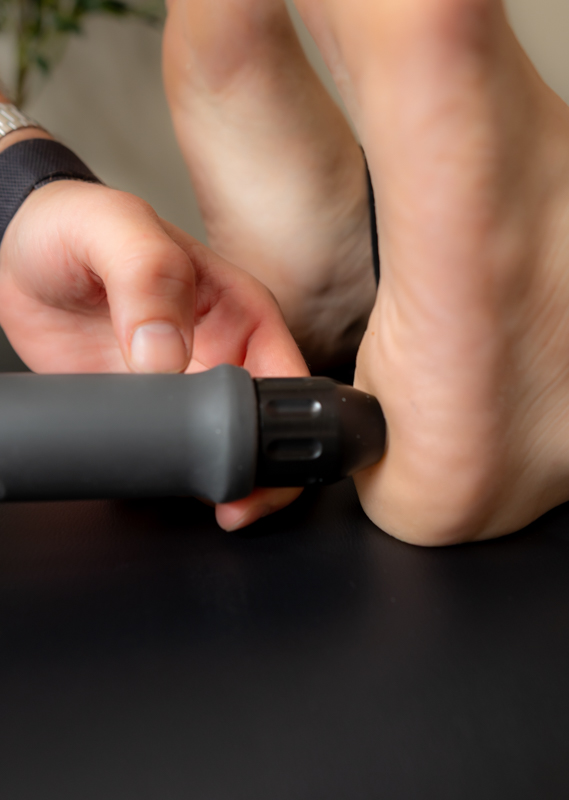
Shockwave therapy applied to the forearm and carpal tunnel can:
- Reduce muscle tension
- Stimulate tissue and nerve healing
This treatment may be provided by our chiropractor or physiotherapist, depending on your care plan.
Laser Therapy (Photobiomodulation)
Laser therapy helps accelerate the healing of inflamed and damaged tissues, reducing inflammation and supporting recovery at the cellular level.
Why Isn’t Massage the First Step?
This surprises a lot of people.
If you have forward head posture, the muscles at the back of your neck tighten to try to pull your head back into alignment. That tightness is protective.
If those muscles are massaged before correcting posture and nerve pressure, the head simply falls forward again — often worsening the original problem.
Once alignment and nerve function are addressed, massage becomes far more effective. Until then, massage is best focused on other areas of the body.
The Bottom Line
The key to lasting relief starts with a thorough assessment to identify the true source (or sources) of the problem — not just the symptoms.
If you’d like to learn more or book an evaluation, contact us at Health Within. We’re happy to help you get to the root of the issue and back to using your hands comfortably again.
The information and opinions shared in this post are those of the author and may not represent the views of all Health Within team members.